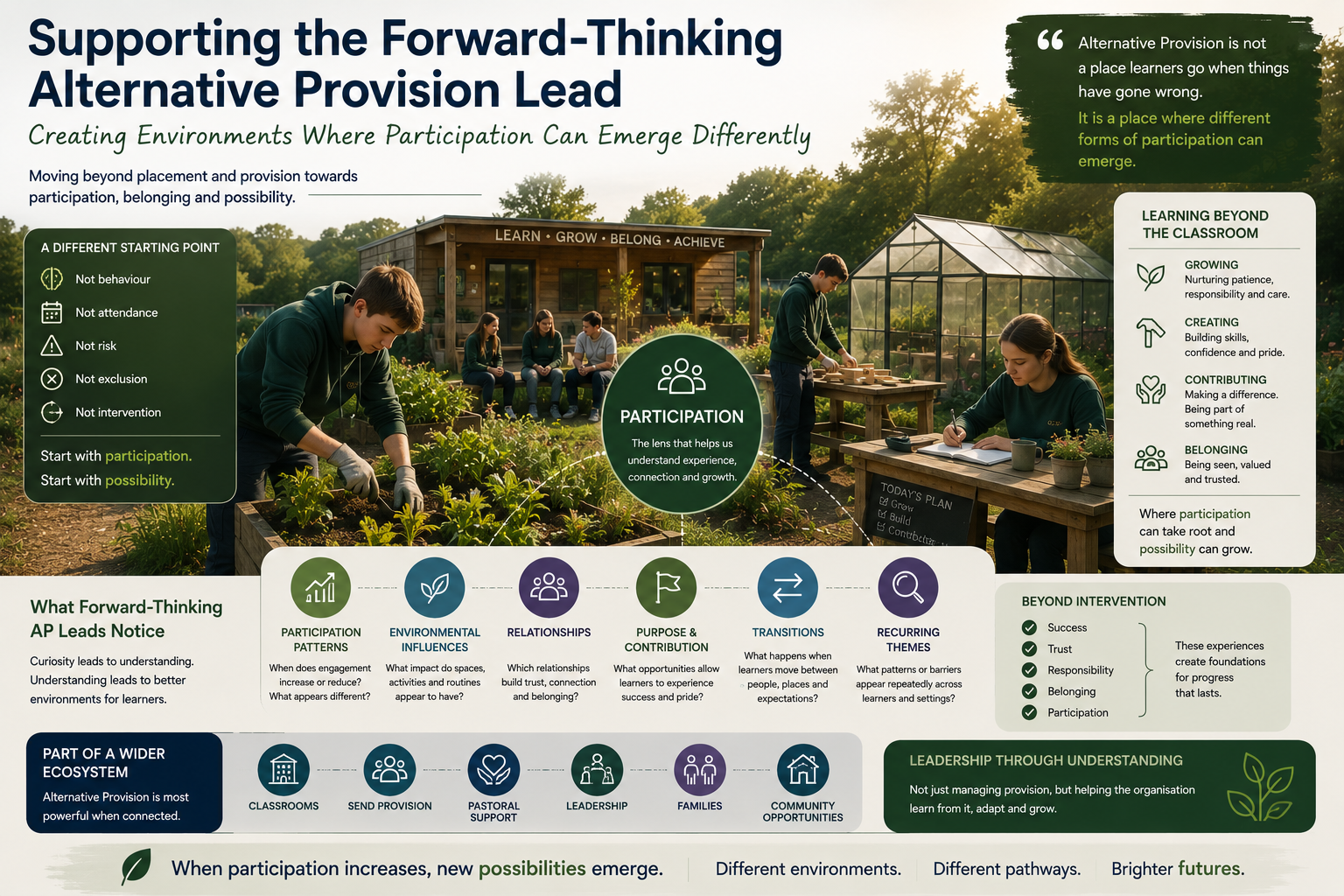
Supporting the Forward-Thinking Alternative Provision Lead
Creating Environments Where Participation Can Emerge Differently
Moving beyond placement and provision towards participation, belonging and possibility
Alternative Provision Is Evolving
Alternative Provision has traditionally been viewed as a place for learners who struggle to access mainstream education.
Many provisions continue to provide invaluable support for learners facing significant challenges.
However, across education, a new perspective is emerging.
Increasingly, Alternative Provision is not simply being viewed as somewhere learners go when things have gone wrong.
It is being viewed as an environment where different forms of participation can emerge.
This distinction matters.
Because it changes the question.
Not:
How do we remove learners from difficulty?
But:
How do we create conditions where participation becomes possible again?
Beyond Placement
Many Alternative Provision leaders invest significant energy into creating environments that feel different.
Different from:
- classrooms
- corridors
- timetables
- traditional expectations
This may include:
- outdoor learning
- horticulture
- practical activities
- community projects
- therapeutic spaces
- nurture environments
- relationship-centred approaches
These opportunities are often highly valuable.
However, an important question remains:
What is it about these environments that appears to support participation?
Understanding this question may be just as important as creating the environment itself.
A Different Starting Point
Many discussions begin with:
Behaviour
Attendance
Risk
Exclusion
Intervention
These concerns are understandable.
However, participation may provide another perspective.
The question becomes:
What conditions allow this learner to engage?
What helps them contribute?
What helps them feel safe enough to participate?
What helps them reconnect with learning?
The Participation Lens
Forward-thinking Alternative Provision leaders often become curious about:
Participation Patterns
When does engagement increase?
When does it reduce?
What appears different?
Environmental Influences
What impact do:
- outdoor spaces
- practical activities
- smaller groups
- quieter environments
- flexible expectations
appear to have?
Relationships
Which relationships appear most supportive?
What creates trust?
What encourages belonging?
Purpose and Contribution
What opportunities allow learners to experience:
- success
- responsibility
- contribution
- achievement
- pride
Participation often increases when learners feel they matter.
Transitions
What happens when learners move between:
- provisions
- activities
- staff
- environments
- expectations
Transitions frequently reveal important insights.
Learning Beyond The Classroom
Forward-thinking Alternative Provision increasingly recognises that learning does not only occur in classrooms.
Learning may emerge through:
Growing
Planting.
Cultivating.
Maintaining.
Harvesting.
Creating
Building.
Making.
Designing.
Improving.
Contributing
Helping others.
Supporting projects.
Working together.
Taking responsibility.
Belonging
Being seen.
Being valued.
Being trusted.
Being part of something meaningful.
The Environment As Teacher
Many Alternative Provision leaders instinctively understand something important.
The environment itself teaches.
A learner may experience:
- calm
- responsibility
- patience
- cooperation
- achievement
simply through participation within a carefully designed environment.
This does not replace teaching.
It expands it.
Beyond Intervention
Intervention remains important.
Support remains important.
Specialist expertise remains important.
However, some of the most significant changes may occur when learners begin to experience:
Success
Trust
Responsibility
Belonging
Participation
These experiences often create the foundations upon which further progress becomes possible.
The Alternative Provision As Part Of A Wider Ecosystem
Perhaps the greatest opportunity lies not in viewing Alternative Provision as separate.
But in recognising it as part of a wider Participation Ecosystem.
Connected to:
- classrooms
- SEND provision
- pastoral support
- leadership
- families
- community opportunities
When these connections strengthen, learners may experience greater continuity and coherence.
Leadership Through Understanding
Forward-thinking Alternative Provision leadership increasingly involves understanding:
- participation patterns
- successful conditions
- environmental influences
- relationship dynamics
- transition challenges
- emerging opportunities
Not simply managing provision.
But helping the organisation learn from it.
Looking Forward
The future of Alternative Provision may not be defined solely by programmes or interventions.
It may increasingly be defined by our ability to create environments where participation can emerge differently.
Environments that allow learners to reconnect with:
Learning
Belonging
Contribution
Purpose
Possibility
Because participation is not simply an educational outcome.
For many learners, participation is the first step towards believing that a different future might be possible.
Continue Exploring
➜ The Forward-Thinking School
How participation thinking can support whole-school development.
➜ Supporting the Forward-Thinking SENDCO
Connecting provision, participation and strategic leadership.
➜ Supporting the Forward-Thinking Alternative Provision Lead
Creating environments where participation can emerge differently.
➜ The Participation & Insight Function
An emerging role within forward-thinking learning environments.
One Question To Take Away
If our provision disappeared tomorrow, what understanding would remain?
And if our understanding improved tomorrow, what provision might become possible?