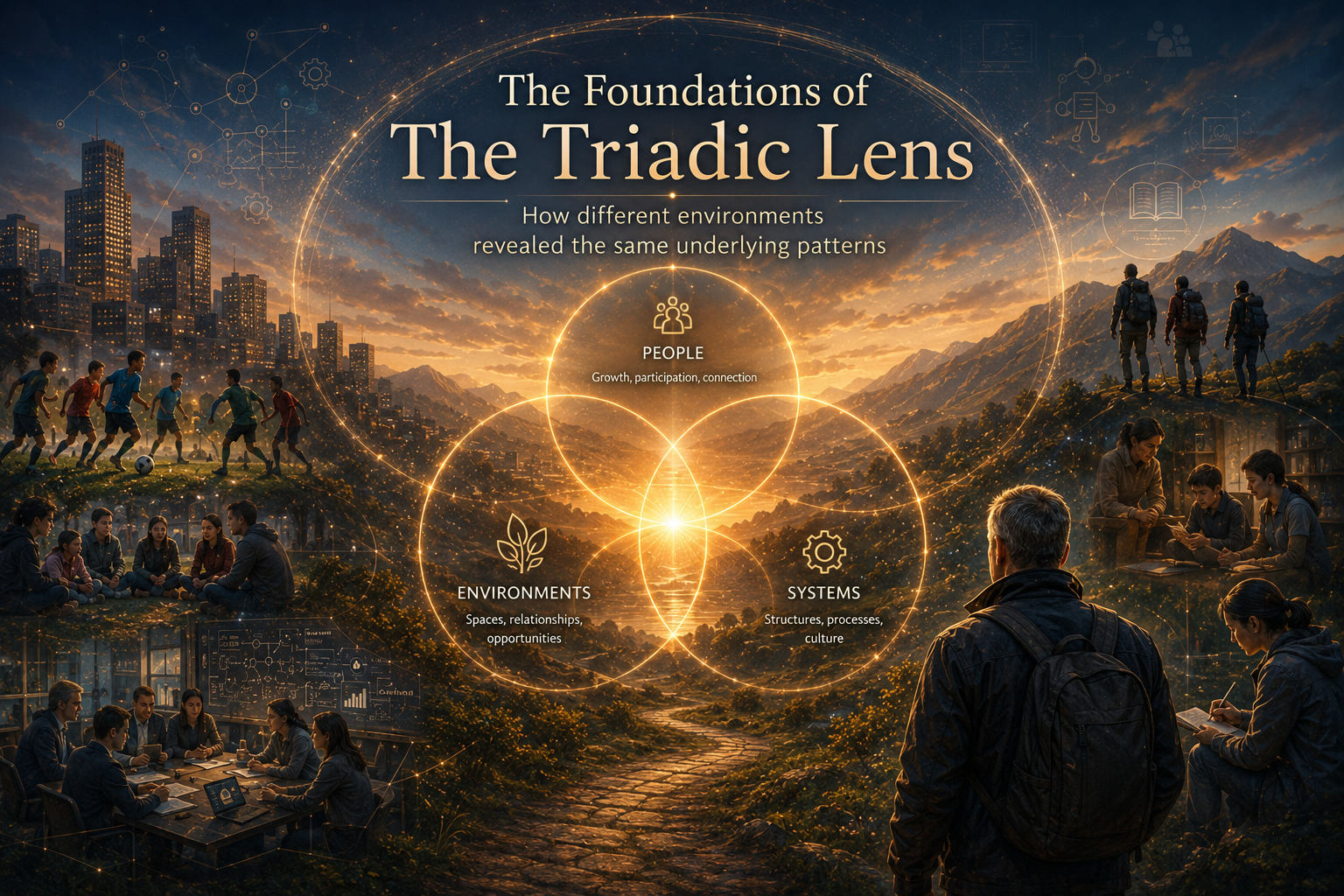
The Foundations of The Triadic Lens
How Different Environments Revealed The Same Underlying Patterns
The environments changed. The questions remained remarkably similar.
The Triadic Lens did not emerge from a single profession.
It did not emerge from a single educational theory.
It did not emerge from a single qualification, book or course.
It emerged gradually through decades of observing people, environments and systems interacting with one another.
Although the environments appeared very different on the surface, the same underlying questions continued to appear.
Questions that eventually became impossible to ignore.
The First Question
The journey began with a simple observation.
People often focused on what they could see.
The visible problem.
The visible behaviour.
The visible outcome.
Yet beneath every visible outcome appeared to sit a wider system.
The more closely those systems were observed, the clearer it became that outcomes rarely emerged from a single cause.
They emerged through interaction.
Understanding Systems
The earliest foundations emerged through work study engineering and management consultancy.
The role involved observing how organisations functioned.
How information flowed.
How decisions were made.
How resources were used.
How people interacted.
How small changes could influence larger outcomes.
The lesson was simple.
To understand outcomes, we must first understand interactions.
Problems rarely existed in isolation.
They were usually connected to people, environments and systems operating together.
Understanding Participation
The next foundations emerged through large-scale sports development and community engagement.
The focus shifted from organisations to participation.
Why did some young people engage enthusiastically while others disengage?
Why did some environments create confidence while others created resistance?
Why did some programmes flourish while others struggle?
The challenge was no longer productivity.
The challenge was participation.
Over time, one observation became increasingly clear.
Participation is influenced by far more than the individual.
Relationships mattered.
Opportunities mattered.
Environments mattered.
Expectations mattered.
Belonging mattered.
Understanding Human Development
The journey then expanded into mentoring, alternative provision, residential childcare and therapeutic support.
The labels changed.
The questions remained remarkably familiar.
Why do some children flourish in one environment and struggle in another?
Why do some interventions create progress while others create little change?
Why do some relationships unlock participation while others create distance?
Again, the answer rarely appeared to sit within the individual alone.
The interaction between the person, the environment and the wider system often proved equally important.
Understanding Learning Environments
Work within schools, colleges, alternative provision and SEND settings revealed the same patterns once again.
Educational systems frequently focused upon:
- behaviour
- attendance
- attainment
- interventions
- provision
These are important.
However, another question repeatedly emerged.
What are we actually seeing?
What conditions support participation?
What conditions create barriers?
What appears to be working?
What appears to be missing?
The more clearly these questions were explored, the more effective decision-making often became.
Understanding Technology
Alongside educational work, a parallel journey developed through digital consultancy, e-commerce and information systems.
Technology presented another version of the same challenge.
How do people interact with information?
How do systems support understanding?
How can complexity be made more accessible?
How can communication become clearer?
The technology changed rapidly.
The underlying questions remained remarkably familiar.
Understanding Reflection
More recently, advances in conversational artificial intelligence introduced a new opportunity.
Not to replace human expertise.
Not to replace relationships.
Not to replace professional judgement.
But to accelerate reflection.
To challenge assumptions.
To test ideas.
To identify patterns.
To improve communication.
To connect observations gathered across many years and many environments.
The purpose remained unchanged.
Helping people understand more clearly.
The Pattern That Kept Appearing
Across organisations.
Across communities.
Across sport.
Across mentoring.
Across alternative provision.
Across SEND.
Across colleges.
Across schools.
Across digital systems.
The same pattern continued to emerge.
People often focused on individuals.
Others focused on environments.
Others focused on systems.
Yet understanding often improved most when all three were considered together.
The Emergence Of The Triadic Lens
Over time, these observations converged into a simple perspective.
The Triadic Lens proposes that many challenges become easier to understand when we examine the interaction between:
People
Environments
Systems
rather than viewing any one of these in isolation.
When these interactions become visible:
- patterns become clearer
- opportunities become visible
- assumptions can be challenged
- participation becomes easier to understand
- decision-making becomes more informed
The Triadic Lens is therefore not a programme.
It is not a therapy.
It is not an intervention.
It is a way of observing.
A way of questioning.
A way of helping individuals and organisations see more clearly.
Why This Matters
Most organisations already contain talented people.
Most organisations already provide valuable opportunities.
Most organisations already possess significant expertise.
The challenge is often not a lack of effort.
The challenge is understanding what is actually happening.
The Triadic Lens exists to support that understanding.
Looking Forward
The future will undoubtedly bring:
- new technologies
- new provisions
- new interventions
- new structures
Yet one capability may remain consistently valuable.
The ability to observe carefully.
To recognise patterns.
To understand interactions.
To learn from experience.
And to ask better questions.
The Triadic Lens emerged from that pursuit.
It continues to evolve today.
Continue Exploring
➜ What Emerged From The Lens?
How decades of observation gradually evolved into:
- The Triadic Bridge
- The Brief Approach
- SuperTeaching
- VFP#1–VFP#5
- Sophia
- Feynman
- AI-supported reflective practice